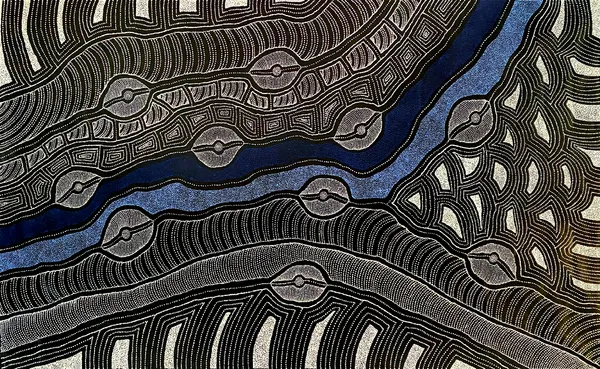
Delvine Pitjara, Aboriginal Artist

LANGUAGE: ANMATYERRE
REGION: ATNELTYE, UTOPIA, N.T.
Delvine Pitjara (sometimes spelled Petyarre) grew up at Atneltye, or Boundary Bore, in the expansive Indigenous homelands region of Utopia, some 240km north-east of Mparntwe (Alice Springs). Delvine is sister to acclaimed artist, Anna Pitjara, and youngest daughter of Glory Ngale (dec.), an esteemed artist and integral participant in the landmark Utopia Women's Batik Project in the late 1980s.
Delvine was born in 1982 — born Patricia Petyarre, she later took the name Delvine professionally — and was the youngest of six children of Glory Ngale and Michael Kngwarreye, her father passing away when she was still a young girl. She attended the Aniltji school at Boundary Bore, and like her sister Anna is related to Emily Kame Kngwarreye and Kudditji Kngwarreye through her grandparents. She began painting for galleries at nineteen, and of all the artists around her it is Anna — whose work she cites as her greatest inspiration — who has most shaped her path.
Delvine paints her country, Alhalkere, using a combination of intricate white dots and fine linework to capture the dry rivulets, creeks, sandhills, soakage sites and other features of the terrain from a topographic point of view. She takes great care in capturing the Dreamings of her father and grandfather's country. Delvine paints in a monochrome or reduced palette, often creating salient features of dotted colour, giving her artworks an effortlessly contemporary aesthetic.
The extraordinary fineness of Delvine's dotting comes partly from her method: rather than a brush alone, she works with small applicator bottles, laying down running lines of minute dots that trace the dry river beds, tracks, soakages and communities of her Country with almost cartographic precision. These topographic paintings sit within a longer tradition — the work of Anmatyerre women at Utopia has always been bound up with the ceremonies that maintain the resources of the land, for bush foods, bush medicines and the health of the people and their Country — so that a map of soakages and yam grounds is never only a landscape, but a record of the knowledge that keeps that country alive.
Utopia is an area that is abundant with the pencil yam, a beloved bush tucker that holds significant spiritual meaning. Delvine is also known to paint Pencil Yam and Yam Seed stories, using fine white lines to depict the sprawling roots of the plant.
Utopia is an area that is abundant with the pencil yam, a beloved bush tucker that holds significant spiritual meaning. Delvine is also known to paint Pencil Yam and Yam Seed stories, using fine white lines to depict the sprawling roots of the plant.
-
 Delvine Pitjara (Petyarre)My Country, 202675 x 150 cm
29 1/2 x 59 inchesacrylic on linenDelvine Pitjara (Petyarre), My Country, 2026$ 2,900.00 -
Delvine Pitjara (Petyarre)My Country, 202670 x 208 cm
27 1/2 x 81 7/8 inchesacrylic on canvasDelvine Pitjara (Petyarre), My Country, 2026$ 3,300.00 -
Delvine Pitjara (Petyarre)My Country, 202692 x 88 cm
36 1/4 x 34 5/8 inchesacrylic on canvasDelvine Pitjara (Petyarre), My Country, 2026$ 1,550.00 -
Delvine Pitjara (Petyarre)My Country, 202590 x 150 cm
35 3/8 x 59 inchesacrylic on canvasSold